Home / Tree Trimming & Pruning
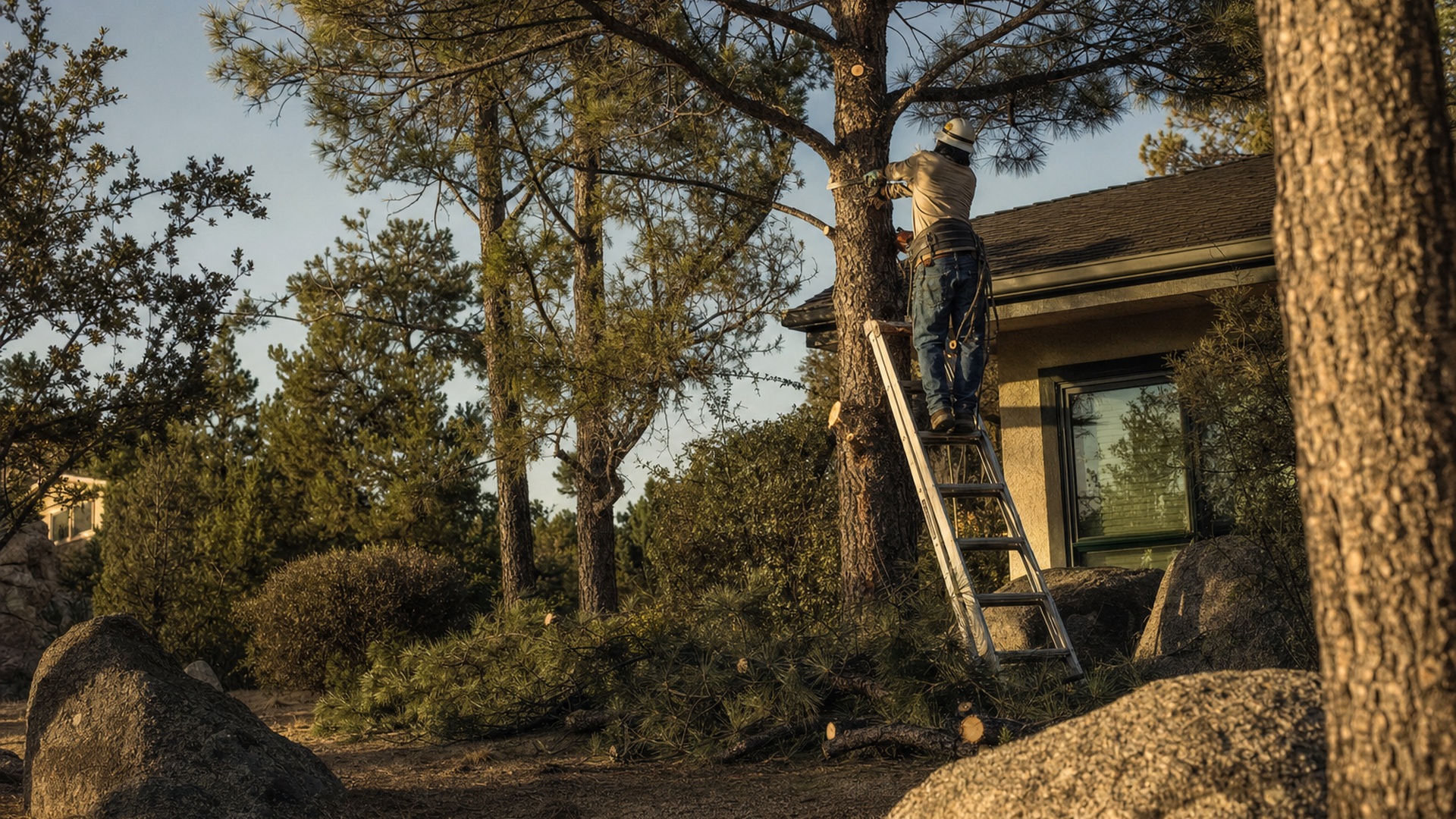
Trimming that makes the tree stronger, not just smaller.
Weight off the wrong limbs, deadwood out of the canopy, clearance over the roof. Cut properly, a pruned tree seals the wound and moves on.
What trimming is actually for
Three reasons to put a saw in a healthy tree: safety, clearance, and wind. Everything else is cosmetic and can wait.
- Deadwood. Grey, needle-free limbs are already detached in every way except gravity. Over a roof, a driveway or a patio they are the first thing to go.
- Clearance. Limbs on the shingles wear through them. Limbs into the service drop are a power problem. Limbs across the driveway scrape the truck.
- Wind. A dense, unthinned crown catches a monsoon gust like a sail. Thinning lets the air move through instead of levering on the root plate.
We don’t top trees
Topping — cutting the leaders off flat to reduce height — is still the most common thing done wrong to trees in this area. It looks like it worked for about two seasons. Then the tree throws a dense mass of weakly attached water sprouts from the cut, the exposed heartwood starts decaying, and you now have a taller, heavier, more brittle problem than you started with, plus a tree that has to be worked on again.
If a tree is genuinely too tall for its spot, the honest answers are a proper crown reduction back to lateral branches, or removal. We will give you whichever one applies rather than the one that is quickest to sell.
Timing
Deadwood and broken limbs can come out any time — a dead limb has no season. Structural pruning on healthy trees is best in late winter through early spring, before the push of new growth. We avoid heavy cuts on stressed trees in the hottest, driest stretch of early summer, since that is when a big wound is most likely to invite borers.
Cabling and bracing
Sometimes the problem is a codominant leader — two trunks sharing one weak union with bark pinched between them. That union will eventually split, usually in a storm and usually taking half the tree. If the tree is otherwise sound and worth keeping, a cable installed up in the canopy can share the load and buy it years. Not every tree is a candidate, and we will tell you if yours isn’t.
Cleanup
Cut limbs go straight through the chipper. Chips can stay for your beds or leave with us. Either way we rake up the debris our own work created before we go.
Common questions
Asked and answered.
How often should trees be trimmed?
Mature ponderosa in a residential yard: every three to five years is typical, mostly for deadwood. Young shade trees benefit from lighter structural pruning every two to three years while you can still influence the shape cheaply.
Can you trim limbs off my roof?
That's one of the most common calls. Limbs resting on shingles grind the surface off them every time the wind blows, and they're a bridge for roof rats and fire.
Limbs near the power line?
We can work near the drop between the pole and your house with proper clearance. Anything on the primary conductors is APS's work — call 800-253-9405 first.
Will trimming hurt the tree?
Correct cuts at the branch collar seal over and the tree is fine. Bad cuts — flush cuts, stubs, topping — are what cause decay. The technique is the whole difference.
How much can you take off at once?
As a rule, no more than about a quarter of the live canopy in a single season on a healthy mature tree, and less on a stressed one. Anyone offering to take half is selling you a problem.
Free estimates
Tell us what the tree is doing.
Call or text and we will come out and look at it. You get a written price, and there is no charge for the visit.
928-232-0011Open 6am–7pm, seven days a week